Showing posts with label Catholic. Show all posts

Saturday, February 20, 2010

Weakness of Faith and the Irish Church Scandal


The Pope's meeting with the Irish bishops over the pedophilia scandal did not bring closure to the crisis.  Nor could it.  This is the long task for the Irish church as it is for the U.S.  From reports, the Pope pointed to a "weakening of faith" as the cause of this crisis.  This seemed abstract to many, even "shocking" to one victim advocate, as most are looking for more resignations and rules.  On the contrary, it is the incisive key not only to the past but to the future where the temptation to power lurks in so many forms.

Faith in Christ engenders the community where trust flowers as in the best of families.  Conversion as a life process is fostered in fellowship and with the sacraments.  Formalistic roles and rituals without the heart of faith resist the change that every human heart requires for healthy relationships.  John Waters, who has been following this crisis at ilsussidiario.net, describes this loss of the practice of faith in recent decades:
Irish Catholicism had long since ceased to offer a coherent version of Christianity to the generations it had itself educated out of poverty and ignorance. Despite the fervent shows of devotion at the time of Pope John Paul II’s visit in 1979, the writing was already on the wall. Although now speaking to one of the best-educated populations in the world, the Irish Catholic Church was still pushing the same limited and simplistic moralism it had promoted in the dark days of post-Famine Ireland, an essentially fear- and rule- based religiosity that achieved no productive engagement with the freedoms that had become available to the generations born after the middle of the 20th century. The scandals of the 1990s and after, therefore, provided the perfect alibi for those generations to reject the Church and all it stood for, exposing Irish Catholicism to charges of rank hypocrisy and enabling many of the formerly faithful to dismiss certain inconvenient elements of the Church’s teaching.
The victim's work is a challenging one.  There is the human need for acknowledgment and for some form of justice, something admittedly in short supply in the real world and even where it should first be found, among believers.  This is owed to those the Church is responsible for in her ministries.  Then there is the need to practice forgiveness, for the good of oneself as well as another, which particularly given the seriousness of the offense can hardly be done without the help of the innocent One who offered himself for every last one of our sins.  This can be a very long process which demands our patience and prayers.

But as Waters points out further on, a scandal is always most convenient for all those who would project all evil outside themselves.
 There are, of course, elements of disingenuousness about these responses. Reports of sexual abuse by priests have been deeply shocking for many people, but few can say that they were unaware of the picture outlined in last year’s Ryan Report, concerning physical abuse and maltreatment of children in church-run institutions over many decades. But, far from relieving the Church’s situation, this has made things worse, because the society now seeks to find ready scapegoats for a cultural phenomenon in which many more people – judges, policemen, social workers, child protection officers – are implicated than are now willing to admit to their roles. For as long as the church remains the centre of attention, the other guilty parties will be able to avoid the wrath of a culture seeking to purge its guilt and shame by expressing as much outrage as is humanly feasible.
The forms of violence that we practice today are not so easily recognized and reviled, but we will be called to account for them later and may not be found innocent.  Speaking of children alone, with abortion as the obvious and catastrophic pinnacle:  we also accept the severing of families as normal; we hand our young people over to "safe sex" practices, short-cutting the maturing process they need for lifelong bonds; we push and stress out and over-medicate kids to produce an image of ourselves that we could never be.  Without faith, which admits that not we but Christ is the answer to our wobbling hearts, we will do all this and more.

Photo: Crucifix, La Mercè Basilica, Barcelona

Wednesday, February 17, 2010

The Catholic Hospital

Msgr. Albacete's column this week at ilsussidiario.net is on the difference of the Catholic hospital:  "What Defines a Catholic Hospital?"  It comes down to presence and hospitality. This difference risks to be lost as Catholic hospitals are bought up by mega-health systems.
I visited my doctor at one such hospital in the Bronx. It used to be called “Our Lady of Victory” Hospital. It was a small, community-oriented hospital, open to the amazing diversity of people in its neighborhood. I remember the statue of Our Lady outside the main entrance as if welcoming the varied sons and daughters into their common home to share, even in the midst of their sickness and pain, the victory of Her Son. The statue is, of course, gone, and the chapel with the Blessed Sacrament is now a meditation room. I asked my doctor’s secretary, a “New York Puerto Rican” whether she has worked there before “Our Lady of Victory” Hospital became part of the Montefiori health care empire, and she said she had. Then I asked whether she noticed any difference now from the way it was then, and she said: “Things are more efficient now, but something is missing, a warmth, a human warmth associated with Our Lady” (I don’t think she had read Dante’s reference to the “caldo…” in his Hymn to the Virgin!).
The threat to identity is not only due to financial strains.  Speaking of another Catholic hospital, Albacete points out that we ignore history and miracles and in particular the Eucharist, which is neglected just where He should be most prominent.
First of all this hospital is the place of the miracle, accepted by the Holy See, that led to the canonization of the first American born saint: St. Elizabeth Seton. On the hallway that leads from the lobby to the elevators there is a big portrait of Mother Seton, at the entrance of the chapel where the Blessed Sacrament is kept. Still I have not been able to find a single person in the hospital who knows this particular and important event in the history of the U.S. The Eucharist is not celebrated in the chapel of the hospital. Instead is celebrated in a nursing home connected to the hospital and at a regular parish down the street, in the same block of the hospital complex.

When I asked one of the sisters who used to run the hospital why no Mass was celebrated at the hospital, she answered: “Because not too many people would be able to attend the Mass, and those who wanted to go could go to the nursing home or to the parish.” I tried to explain to her that the celebration of the Eucharist has nothing to do with number of people that attend. If only one person, one patient could go it’s worthwhile; in fact, if no one goes, Mass is still a miracle at the source of all miracles, including the one that led to Mother Seton’s canonization. Our relation with the Eucharist is the first stage of what makes us human and therefore of the warmth that defines a true Catholic hospital.
What is true for the Catholic hospital is true for the Catholic school is true for the Catholic social agency.  In the large network of state-funded Irish orphanages of decades ago, evidently the Catholic presence was lost, and institutions became horrors. 

I was struck by what Fr. Carron said some time ago about missionary efforts by AVSI, that even when more funds are available, they would never set up a mission without the presence of those believers who carry this awareness with them.

Saturday, April 4, 2009

Catholic Senators Vote Against Freedom of Conscience for Health Care Workers

Troubling news comes from CNA about a majority of Catholic senators voting against a conscience protection amendment yesterday that keeps health care workers from being forced to participate in abortion-related and other morally objectionable services.
Senator Tom Colburn’s amendment states, "To protect the freedom of conscience for patients and the right of health care providers to serve patients without violating their moral and religious convictions."

The amendment was voted down by a margin of 41-56, in which a majority of Catholic Senators voted against the amendment 9-16. The failure to pass this legislation now leaves the door open for the Obama Administration to rescind the law by executive order and force health workers to compromise their moral convictions.
A good number of senators voted in favor of this amendment suggesting it was a reasonable amendment.  It wasn't a matter of restricting abortion but of protecting freedom of conscience, not for some obscure cultish scruple, but in a hotly contested moral arena.  This is after Cardinal George's very public appeal to Catholics to advocate for these conscience protection rules.

It is becoming more evident that the Church is the main defenders not only of life, but of freedom.

Thursday, April 2, 2009

Culture and Identity in the Current Crisis

Now I'll be almost the last to weigh in on the Notre Dame controversy, except for perhaps Suzanne (unless I've forgotten). Here's Stephen, Fred, and Deacon Scott as well as a more general observation which I thought pertinent from Conjectures, a quote from Bishop Blase Cupich of South Dakota who warned his fellow bishops that “prophecy of denunciation quickly wears thin.” I'll post here in case we take it up together since for some reason it just won't die.

I'm also (like Stephen) not shocked or particularly surprised by Notre Dame's decision. I've both attended and taught at mainstream Catholic colleges. I'm mildly curious about why Bill Clinton isn't on the list of presidents who received this honor (was he asked? did he refuse?). It would be more useful, in my opinion, to put resources to fighting the erosion of conscience protections for health care workers than to fight this battle.

Some years ago at the national diakonia in Chicago, we heard Cardinal George speak about the original immigrant culture of Catholics which really never took root in the American culture. It has been a while, so I may be overstating this observation, or not. Instead Catholics after some generations assimilated to the culture. You can find some of this thought of his in an interview with John Allen, where he said:
[W]e created alternatives to the mainstream institutions. They were never, I think, ghetto institutions, because they prepared people to take their place in mainstream society. They didn’t try to cut them off from it, but to prepare people to take their place in the mainstream precisely as Catholics. Once they succeeded, then the value of those very institutions seemed to be lessened, and the institutions themselves said it’s important for us to be mainstream, and to no longer be so identifiably Catholic. So they’re porous in ways that they weren’t before....
Notre Dame, perhaps the most prestigious Catholic institution in the country, is an example of this ambiguity, at least in respect to the current controversy.  It's certainly not true of the entire institution, as witnessed by various friends of mine.  Note that the response to such ambiguity often has been to again set up alternate institutions, separate and culturally apart.  This counter-culture is robust, though we may wonder how significantly it leavens the common culture.

What bothers me most about the current debate is the painful public lack of unity which is probably not helped by the Catholic blogosphere. Tangentially, there was the set-up with Archbishop Burke which was part of a lay campaign to remove bishops who were not aggressive enough in denying communion to pro-choice Catholic politicians.  That most saddens me, some of our finest pastors, denounced for their own pastoral approach.

The entire situation we find ourselves in today, since the November election, reminds me of the 1968 crisis Fr. Giussani spoke about in 1972 in his talk "The Long March to Maturity". Perhaps the crisis itself was quite different, but the challenge of our response is really the same.
Perhaps it is useful to remember that in the life of those He calls, God never lets anything happen unless it serves for the growth and maturation of those He has called.

This is so above all for the life of the individual, but in the final analysis, and more profoundly, for the life of His Church, and therefore, analogously, for the life of every community, be it a family or an ecclesiastical community in the broadest sense. God never permits anything to happen unless it is for our maturity, our maturation...

This, we can say, is the indicator of our faith’s truth, its authenticity or lack thereof: if the faith is truly in the foreground, or if in the foreground there is another kind of concern; if we truly expect everything from the fact of Christ, or if we expect from the fact of Christ what we decide to expect, ultimately making Him a starting point and a support for our projects and programs.
Now look at Fr. Giussani's judgment of the "Reduction of the Christian Fact", which could not sum up better the risk we take right now in our political *reactions*.  A campaign even for a good cause becomes an ideology.  As if solving the political problem would conquer the evil.
What were the consequences identifiable in the attitude assumed by this large sector of the Movement in the era we are commenting on?

a) First, as it says on the sheet: “An efficientistic conception of Christian commitment, with accentuations of moralism.” Not accentuations–with wholesale reduction to moralism! Why should anyone remain Christian? Because Christianity pushes you to action, presses you to commitment, no other reason! It’s like a father and mother who tell you, “Come on, you have to do this!” and then they leave you alone to do it yourself, as if they weren’t there. (Instead, Jesus says, “I will be with you to the end of time.”) This is a concept of incarnation in which the Christian is truly cut in half, cloven in two. And from the contingent, historic point of view, Christians still have the right to remain in the world only to the degree in which they throw themselves into worldly action: it’s ethical Christianity, that is, Christian ethics, Christian behavior, which means being Christian in the world identified with worldly commitment....

b) Second consequence (and this is the gravest thing): the incapacity to “culturalize” the discourse, to bring one’s Christian experience to the level in which it becomes systematic and critical judgment, and thus a prompt for a modality of action. It’s the Christian experience blocked in its potential for impact on the world, because an experience impacts the world only to the degree to which it reaches a cultural expression (which doesn’t mean only to the degree to which it reaches the university–this has nothing to do with it!). Cultural expression means judgment, capacity for systematic and critical judgment of the world, of worldliness, of the historic circumstance, and thus it becomes a suggestion for a modality of program and of action.

Experience that doesn’t reach this point has no face, lacks a face in history; it has no face and therefore can subsist for a long time in “pre-historic” eras, but to the degree to which the relationships in society, in human life become denser, press against that experience, it disappears, because it’s alienated in the pressures of the environment. ...
Our experience disappears.  How tragic.

So how do we respond?  What kind of campaign should we raise?

I remember being so struck by this text by Fr. Giussani when I first read it as another way to proceed:  this method, which is following, obedience, something far more solid than my own presumption.
In any case, the methodology is faithfulness to experience. I don’t know whether anyone here has remembered in this moment what it says in the premise: that Christianity spreads in the world not because of our work, but by the grace of God. So then, leaving behind our immaturity, becoming mature, is a grace of the Spirit within us. Let’s keep reminding each other! The Holy Spirit descended where they were gathered together in the Cenacle, where they were all gathered together. The Holy Spirit descends upon our communion. Therefore, for example, a “settlement” is an outcome of cultural expression, but before being an outcome of cultural expression, at least as a tendency, it’s the premise for cultural expression. In fact, our maturity is expressed in our passionate desire that the Church of God live visibly here where we are, in our striving that it be lived here, and therefore that Christian communion be built here and wherever we are, so that this “new person,” this “one body” as Saint Paul says–“in which there is neither man nor woman, neither Greek nor barbarian, neither left nor right” (“All of you are one, one person in Jesus Christ”)–may bring good to the neighborhood, university, work, parish… bring good to the world, as an incarnate presence, incarnate!

But the logic of the incarnation, that is, the logic of mission, happens entirely in us, because the incarnation in the world, in the sense of interest in and help for the world’s problems, of real collaboration in the world’s struggle for authenticity, is only a ray of light, only an inevitable consequence of those problems, of the world’s needs, of flesh and blood, of the world, of life lived as Christian community, converted, translated in terms of faith. Incarnation doesn’t mean getting involved in the labor union, the factory, or university. Incarnation, that is, mission, is living the university, the factory, etc., as communion. It doesn’t mean getting involved in this or that cultural or practical or socio-political problem, but living our whole humanity as communion.
I remember once, in a time of great trial, when we were living hard things faithfully and enduring the lack of understanding of others, thinking that "living well is the best revenge". We were certain that all would be well if we held onto the One we trust. How many psalms state just this in every situation of threat, injustice and untruth.

The only way, it seems, is to live this communion in the place where Christ is present, this living experience.  However awkward, rough, we hold to this communion which is home to this life-giving experience, a house with a necessary human structure.  It isn't for us to save the world, but to witness by our unity to One who is saving all.

Thursday, March 5, 2009

A shrewd observation

Yesterday I was reading an address by philosopher Peter Van Inwagen entitled Quam Dilecta. It is a very good and accessible description of faith and reason and how they work together in the life of this prominent philosopher. In the course of the biographical portion of his address, he discusses his belonging to the Episcopal Church and how his belonging illustrates "Robert Conquest's Second Law: Every organization appears to be headed by secret agents of its opponents."

Of course, my purpose for citing this is that it is a universal law, not limited to Episcopalians.

Thursday, December 25, 2008

Christmas Message from Bethlehem

From the Christmas Message 2008 By H.B. Fouad Twal
Latin Patriarch of Jerusalem


Dear brothers and sisters,

With joy we would like to announce to you the desire of His Holiness Pope Benedict XVI, to visit the Holy Land, as a Pilgrim next May. The Supreme Pontiff, wishes to pray with us and for us, and to acquire a first hand knowledge, of the hard conditions of our region. We are confident in the Lord, that this pontifical pilgrimage and pastoral visit, will be a blessing for us all, as well as a substantial contribution, to a better understanding among the various nations of the region, lifting the barriers and helping solve the problems, removing distress and consolidating good relations among peoples, religions and denominations, in security and peace.

From Bethlehem, I call upon my Brothers the Bishops and other world religious Leaders, the religious Orders and Congregations, the Consecrated persons and all other people of good will, the Pilgrims and all those who love the Holy Land: please, remember Bethlehem and Jerusalem in your prayers! The Holy Land appeals to your conscience and entreats your support. Do not leave it alone in its distress. Assist it so that it might become and remain a land of love, peace, reconciliation and equality among all its children.

O Infant of Bethlehem, you who wanted to be born in silence and stillness, plant in our hearts a love for peace, justice and serenity! You, who have experienced poverty, wandering and fear, have pity on our poor, our wanderers, our prisoners and refugee camp dwellers!

O unlimited God who, in your incarnation, accepted to experience the limits of time and place: you knew the limits of place, by being born in a grotto and being compelled to escape and wander; you knew the limits of time, when you dwelt in the holy womb of the Virgin. You, who with your mother Mary and guardian Joseph were, in the Grotto, the model of refugees and rejected people, sanctify your- Country, so that your name be hallowed everywhere, and that we draw closer to You and to each other, under the hard circumstances ,in which we live.

O Infant of the Grotto, who rejected violence, homicide and hatred, you, whose Birth, divided History into two – the old and the new, before Christ and after Christ, expel war from your homeland, and bring an end to the destruction of its homes. Sow the seeds of brotherhood! Grant to the afflicted and the poor, hope and comfort! O You, the Poor, the Fugitive and the Persecuted One, look upon those who emigrated from Jordan, Palestine, Lebanon, Iraq and other suffering countries. May your Homeland ,be the Land of blessings and prosperity, where the followers of all religions meet in harmony, so that "no nation raises the sword against another." (Isaiah 2:4) May our faithful celebration of your Birth, be the birth of a new era of peace, stability and security, Amen!

+ Fouad Twal, Patriarch

Wednesday, December 24, 2008

Christmas and Hope, Julian Carron

Christmas and Hope
Letter to the editor of the Italian Daily La Repubblica,
published December 23, 2008

Dear Sir,

I was struck by the readings that the Ambrosian Liturgy proposes for Monday if the third week of Advent. How must the members of the ancient people of Israel been disconcerted at the words of the prophet Jeremiah: “It will devour your harvests and your bread; it will devour your sons and daughters; it will devour your flocks and herds; it will devour the fortified cities in which you placed your trust” (Jer 5:17). He was telling them that another nation was going to conquer the kingdom in which they had put their trust. “Then, if they say: ‘Why has the Lord our God done these things?’, you will answer: ‘Just as you have abandoned the Lord and served foreign gods in your country, so will you serve foreigners in a country that is not yours’” (Jer 5:19).

It is as if this were said for us; today we see signs that make everyone afraid, it seems that what has supported our history is unable to withstand the test of our times: one day the economy, finance and work, the next day politics and the judiciary, then the family, the beginning of life and its natural end. So, like ancient Israel before a frightening situation, we, too, ask ourselves: “Why is all this happening?” It is because we, too, have been so presumptuous as to think that we can still get along after cutting the roots that supported the foundations of our civilization. In recent centuries, our culture has believed it could build a future for itself while abandoning God. Now we see where this presumption is leading us.

Now, what does the Lord do in the face of all we have brought upon ourselves? The prophet Zechariah tells us, speaking to his people Israel: “Look, I am going to send you my servant Branch” (Zc 3:8.). Notice the name. It is as if before the crisis of a world, our world – the prophets would describe it with an image dear to them, that of a dried-up trunk – a sign of hope were springing up. The enormity of a dried up trunk cannot prevent the sprouting of a humble, fragile branch in which lies the hope for the future.

But there is one drawback: we, too, when we see this branch appearing –like those before that child in Nazareth—can be scandalized and say: “How can something so ephemeral be the answer to our need for liberation?” Can salvation come from something so small as faith in Jesus? It seems impossible that all our hope can rest on belonging to this frail sign. The promise that only from this can everything be rebuilt seems scandalous. Yet men like St. Benedict and St. Francis started from that. They began to live while belonging to that branch that had grown through time and space—the Church, and in this way became protagonists of a people and of history.

Benedict did not face the end of the Roman Empire with anger, pointing the finger at the immorality of his contemporaries, but rather witnessed to the people of his time a fullness of life, a satisfaction and a fullness that became an attraction for many. This became the dawn of a new world, small as it was (almost a nonentity compared with the whole, a whole that was in total collapse), but a real world. That new beginning was so concrete that the work of Benedict and Francis has lasted through the centuries, has transformed Europe, and humanized it.

“He has revealed himself. He personally,” said Benedict XVI, speaking of the God-with-us. Fr. Giussani told us, “That man of two thousand years ago is hidden under the tent, under the appearance of a new humanity,” in a real sign that arouses the inkling of that life that we are all waiting for so as not to succumb to the evil in us and to the signs of the nothingness which is advancing. This is the hope that Christmas announces to us, and that makes us cry out: “Come, Lord Jesus!”

Julián Carrón

Saturday, December 20, 2008

Golgotha in Vietnam

A pitched battle is on in Vietnam between the Catholic church and the government. Several Catholics were recently tried and given sentences of house arrest and probation for the government's appropriation of church property. The government has demanded the expulsion of the Redemptorists from Hanoi. And a monastery is about to be torn down and the land converted into a public park.

Vietnamese authorities appear to have adopted a policy of turning Church property into green spaces, AsiaNews says. "Or perhaps it is a vendetta against local Catholics whose protests prevented them from selling the land to private interests."
Sandro Magistra recently reported on the Vietnamese bishops' reports of their church's struggle during the recent Synod.

At the synod taking place at the Vatican, there are two bishops from Vietnam: the bishop of Nha Trang, Joseph Vo Duc Minh, and of Thanh Hóa, Joseph Nguyên Chi Linh.

The latter of these, speaking on the morning of October 13, called the Church of Vietnam "one of the Churches most harshly tested by bloody and uninterrupted persecution."

But immediately after this, he encouraged those present with this passage from the conciliar constitution "Gaudium et Spes":

"The Church admits that she has greatly profited and still profits from the antagonism of those who oppose or who persecute her."

Proof of this "profit" – he said – is found in the flourishing of conversions in Vietnam, and the growing respect shown to Catholics for their extensive work in defense of motherhood, in a country with an extremely high abortion rate.
Yesterday, Hanoi priest Joseph Nguyen warned that the persecution will be ongoing.

“The Church needs to prepare for more persecutions,” Hanoi priest Fr. Joseph Nguyen warned, suggesting that a careful reading of Chairman Thao’s letter shows that he did not actually expect the Redemptorists to be transferred. “He expected and truly wanted the Church leaders to say no,” Fr. Joseph Nguyen claimed.

“The tone of the letter was so hostile, and so demanding. It also upset readers with the word ‘god’ in small case. It was not in tune with the claimed intention.

“What Thao really wants now is a good excuse for administratively coercive measures. Please pray for the Church in Vietnam. As Christmas draws near, we are still at the Golgotha on the Good Friday,” he concluded. (Catholic News Agency)

Wednesday, November 26, 2008

Party Soul-Searching

Deacon Scott pointed to a couple of articles on his blog on the election post-mortem from the point of view of Christian interests. I pass on a few of his quotes.

Ross Douthat's The Moral Obligation To Study Election Returns, in which he correctly chastises George Wiegel's take on the election...

I agree very much with a comment made by one Traductor, on a post over on Paper Clippings: "Catholics need to start proposing Christ and the possibility of a new humanity that is born out of the encounter with him. Some fights may be necessary, like protecting the freedom of Catholic works like hospitals, but history has shown that we will always be on the losing side of a war over 'values.' As Obama himself said, 'Don't bring a knife to a gunfight.' The bishops need to focus on educating their flocks, or else when and if they stand up, there may be no one behind them."

This puts me in mind, once again, of something Msgr Albacete said:
"We do not have the problem, or the mission, to construct a bridge between faith and politics. We do not have this problem. To have this problem and to attempt to solve it, already violates our humanity. Every single attempt to build this bridge has been a weakening of faith, or a betrayal of the Incarnation. And historically, there have been many attempts."

Let me add one from British philosophy professor John Haldane of The Witherspoon Institute, "Letter to America on the Future of Social Conservatism". It may be helpful to compare European Christian political experience when charting our own attempts to bring Christian values to bear in the public square. The article is worth a close read because of Britain's experience, where conservatives are abandoning pro-family platforms to pursue their pet economic and foreign policy agendas, a real risk now within our country's Republican party under reconstruction.
It has been a mistake for moral conservatives to associate their concerns with opposition to one candidate and one party. Not only has the previous administration proved itself unworthy, but the state of the Republican party continues to be divided over values such that, had it won the White House and Congressional elections, it would not have delivered a range of policies that would have addressed moral concerns about the conduct of war, the management of markets, the securing of marriage, or the protection of the unborn.

While it would be wrong to abandon the political parties, it would be equally mistaken to side with one of them. The fact is that elections will always be fought and decided on a range of issues and the balance will sometimes favour one side, then another. Social conservatives who look to politics should be seeking to work within both parties, and in the case of the Democrats, seeking to return them to a historical position that was once more in line with Christian moral values and Catholic social teaching than was that of the Republicans.

There is also a further reason to be wary of confusing moral concerns with the fortunes of a political party. Those within a chosen party whose primary interest is pursuing electoral victory may prove fiercer enemies of one’s moral position than political opponents in other parties....
Haldane predicts this will continue to be an uphill battle, but our work is to educate and persuade with a positive message more than via attacks. Ultimately, our task is to witness, even if we don't win.
What are you, and we, to do? The answer can only be to go on as we have learned to do already, arguing the case, fighting the battles, seeking to influence policy, but not investing our hopes in political parties that are more like one another than they are like us. Perhaps American social conservatives might reflect on that experience and prepare themselves for what are likely to be very difficult times ahead.

Tuesday, November 4, 2008

The Catholic Vote in the United States

[This article was written for the Italian website IlSussidiario.Net site and published in translation yesterday.]

For the last century, Catholics have formed a solid voting bloc of the Democratic party, even electing one of their own, John F. Kennedy, in 1960. The original party claims Jefferson and Madison as founders, though the Democratic party as we now know it dates to the 1828 election with Andrew Jackson carrying the populist and expansionist movement of the time. The Democrats were the party of the South before the the Civil War, and the split of two Democratic tickets (one southern pro-slavery and the other northern states rights) in 1860 allowed Abraham Lincoln to capture the election. Democrats then languished until the Great Depression.

In 1932, Democrat Franklin D. Roosevelt was elected with the help of Catholic ethnic groups, and Democrats ruled with a philosophy of centralized government and the expansion of social programs for the next decades until the turbulent sixties. Subsequently, cultural issues pushed working-class and southern voters including Catholics toward the Republicans, and the tipping point came with Ronald Reagan's election in 1980 with his cadre of Reagan Democrats. Although Bill Clinton presented himself as a moderate, the Democratic party has recently offered left-leaning candidates, including John Kerry in 2004, who normally lose when perceived as too liberal for the country's sensibilities. In the current election, Barack Obama is running as an ideological liberal with long-time Catholic senator Joe Biden as a running mate who is also pro-choice. Obama has the political advantage of following the very unpopular administration of George W. Bush, with two wars and a harrowing economic crisis in process.

Since the 1972 Supreme Court decision of Roe v. Wade, abortion has remained a hot topic in every presidential election. Evangelical Christians and Catholics formed a conservative alliance to keep the pro-life issue up front. Catholics have fluctuated between their Democratic Party of origin which is unequivocally pro-choice but favorable to the social justice concerns Catholics learned in Catholic institutions, and the pro-life Republican party with harsher economic policies, an anti-immigrant contingent and now the war in Iraq which was opposed by the Church. The Catholic vote, which makes up one-quarter of the electorate, is crucial for an election. Bill Clinton won a 9% lead among Catholics over George H.W. Bush in 1992; Al Gore had only a 2% advantage over George W. Bush in 2000; but John Kerry, who ran as a pro-choice Catholic, lost the election in 2004 against George W. Bush by 5% among Catholic voters after a public correction by the country's Catholic pastors for giving scandal with his pro-abortion voting record.

Although George W. Bush courted Hispanics for his 2004 reelection campaign, a clamp-down on immigration policy, including workplace raids and deportations which split families, followed the last election. Hispanic Catholics, more than a third of the faithful, were particularly alienated during this primary season as the Republican candidates vied to show the strongest anti-immigration policies, even if McCain was the moderate of the group on that issue.

Also during this presidential election cycle, a vocal group of Catholic law professors led by Doug Kmiec, former legal counsel for Presidents Ronald Reagan and George H.W. Bush, have asserted that Barack Obama is the true "pro-life" candidate over John McCain, because the Democratic candidate favors social programs that would prevent unwanted pregnances and offer more help to mothers. It is not a new argument, as the pro-life and social-justice division, exploited by the political parties, has become more unpalatable to "seamless garment" Catholics, as the late Joseph Cardinal Bernardin's described the holistic approach to life issues. Although John Kerry was backed by pro-choice Catholics, Kmiec, who considers himself anti-abortion, has become the spokesman for the theory that the pro-life cause can be promoted via a pro-choice candidate with better social welfare programs. Kmiec asserts that the legal battle cannot be won anyway, since a Supreme Court reversal would only move the fight to the state level, so he argues that Catholics should vote for Obama who claims he will "reduce the... circumstances" of abortion. Pro-life advocates have rebutted this argument with the fact that Barack Obama has the most pro-choice record of any candidate yet: he voted against banning partial-birth abortions and has promised to sign into law the Freedom of Choice Act which would override any state restrictions on abortion and remove a conscience clause for health practitioners.

Throughout the current campaign, the Catholic bishops have reiterated the criteria they put forth in their letter "Faithful Citizenship", that among political issues abortion takes precedence because it is an intrinsically evil act and therefore a "non-negotiable". And just as Doug Kmiec published a book with his theory on why pro-life Catholics should vote for Obama, Denver Archbishop Charles Chaput put out a book Render Under Caesar discussing Catholic participation in political life. Archbishop Chaput recently fired back at Kmiec's political reasoning in a speech to a Catholic women's group: "I think his activism for Senator Barack Obama, and the work of Democratic-friendly groups like Catholics United and Catholics in Alliance for the Common Good, have done a disservice to the church, confused the natural priorities of Catholic social teaching, undermined the progress pro-lifers have made, and provided an excuse for some Catholics to abandon the abortion issue instead of fighting within their parties and at the ballot box to protect the unborn."

Saturday, November 1, 2008

QOTD: Government and the Common Good

"Government is the exercise of the virtue of prudence in the enactment of legislative and executive measures capable of directing social activity towards the common good. The principle of subsidiarity requires that governments and large international agencies ensure solidarity on the national and global levels and between generations."
Archbishop Celestino Migliore, permanent observer of the Holy See to the United Nations, 10/31/08

Tuesday, October 21, 2008

An Original Catholic Political Culture

From Paper Clippings by Crossroads.
It is appalling that an intelligent Catholic layman like E.J. Dionne accepts as a the normal state of affairs that US catholics should be divided "conservative" and "progressive" groups. It is a sad truth that US Catholics think of themselves according to such external political categories. But do they realize this a symptom of complete cultural failure on their part? If you let the secular culture set the terms of the debate to the point that you end up dividing the Church exactly along the same political lines as the rest of society, that means you have not done your homework in developing an original Catholic political culture. It is a shame, really.

Let's begin.

Wednesday, October 15, 2008

"Life Is a Calvary" in Iraq

Yesterday, the Synod in Rome heard from the church of the martyrs through their pastor, Cardinal Emmanuel III Delly, patriarch of Babylon of the Chaldeans.

The situation in some parts of Iraq is disastrous and tragic. Life is a Calvary: there is no peace or security, just as there is a lack of daily necessities. There are continuing shortages of electricity, water, gasoline, telephone communications are increasingly difficult, entire roads are blocked, schools are closed or always in danger, hospitals are on short staff, the people are afraid for their safety. Everyone is afraid of kidnapping, frightened by the intimidation. And what can be said of the unjustifiable kidnappings that take place on a daily basis, harming entire families and often depriving them of their loved ones, even though they have paid tens of thousands of dollars for a release that never happens? Not to mention the increasing number of deaths caused by car bombs and suicide bombings. (Asia News)
Cardinal Delly offered his contribution to the Synod with the witness of his people:

Living the word of God, for us means bearing witness even at the cost of our own lives, as has taken place and is still happening with the sacrifice of bishops, priests, and faithful. They remain in Iraq, strong in faith and love of Christ, thanks to the fire of the word of God. For this reason, I beg you to pray for us and with us to the Lord Jesus, the Word of God, and to share our concerns, our hopes, and the pain of our wounds, so that the Word of God made flesh may remain in his Church and with us as good news and as support. Sixteen of our priests and two of our bishops have been kidnapped and released after an extremely high ransom. Some of them belong to the ranks of the new martyrs who today pray for us in heaven: the archbishop of Mosul, Faraj Rahho, Fr. Raghid Ganni, two other priests, and six more young men. (Asia News)
Half of the previous Christian population of Iraq of 1.4 million has fled the country, while those who remain are too poor to leave. The acts of terror include:

• A Catholic and a Syrian Orthodox church in Kirkuk, as well as an Anglican church and the Apostolic Nuncio’s residence in Baghdad, were bombed in January 2006, killing three people.
• In September 2006, two other churches were attacked, in Kirkuk and Baghdad, killing two persons, one a child.
• Fr. Boulos Iskandar Behnam was kidnapped and murdered. His head had been sliced from his body and placed upon his lifeless chest.
• In December 2006, a high ranking member of the Presbyterian Church in Mosul was murdered.
• In May 2007, St. George’s Church Baghdad’s Dora neighborhood was bombed for a second time.
• In June 2007, a Catholic priest and three deacons were murdered outside of their church after saying Mass in Mosul. (NCR Cafe)

In recent days, the attacks against Christians have intensified in Mosul. A church was bombed and partially damaged.
Haitham Haazem, a Christian who fled to Baghdad from Mosul with his wife on Sunday, said Iraqi forces had restricted themselves to fixed checkpoints and had
little control over entire neighborhoods on the east side, where killings and intimidations took place. (New York Times)
Meanwhile, there is no agreement for our continuing military involvement in Iraq after the end of the year. (Washington Post)

As our involvement and interest in Iraq wanes, it remains to be seen how we will fulfill our obligations to this fragile population persecuted and displaced by the war we waged.

Sunday, October 5, 2008

Reason is the need for the Infinite...

As I was doing some research for another project, I stumbled on an interesting article, "My Catholic Faith Pushes Me to Obama," by Kari Lundgren.

In her article, Kari provides a quick sketch of her college experience "as a conservative Catholic single-issue voter":
I quickly joined Students for Life, the campus pro-life group, and began spending Saturday mornings with 6 am mass and an hour drive to Pittsburgh to pray in front of the abortion clinic. That first year I was a bus captain on the trip to Washington, D.C. for the March for Life, as well as head of the Students for Life Prayer Team. I was interviewed on the conservative Catholic TV station EWTN as a young pro-life leader.

...I also volunteered at the local crisis pregnancy center, where we offered free pregnancy tests, infant formula, children's clothing, and other services to help women who were pregnant and needed extra support. I went to daily mass and weekly confession, as I had since high school. I marched in the occasional local abortion protest. I read theology in my free time.

I was, in other words, the perfect Steubenville Catholic student: devoted to my prayer life, diligent in my studies, involved in student life, and passionate about the pro-life cause.

Later, Lundgren experienced a kind of conversion:

...While I prayed for an end to abortion and the conversion of souls, I also saw the depressed ex-steel town in which the university resided, and I felt a disconnect between the spiritual fervency on campus and the poverty surrounding it. I was ashamed to have the money to be a full-time student when the neighborhoods next door to the university were filled with dilapidated houses and people forced out of work when the steel mills closed. Big questions started plaguing me: Was it really enough to make these people observant Catholics, as the general thinking on campus went? Were all of their socioeconomic problems really caused by the fact that they used birth control? Would overturning Roe v. Wade really be enough to solve the poverty, under-education, and chronic unemployment rampant in the town and the world?

These questions led her to reject what we might quickly (if inaccurately) refer to the "Steubenville solution." She found "better" answers to her questions in the rhetoric of the political left.

There are, as of this writing, 168 comments following her article. The commenters split rather cleanly into two camps: Catholics who disapprove of Lundgren's conversion on the one hand and on the other hand, supporters of Obama who cheer her on. Meanwhile, not one person posed the questions that most interest me:

Why, as an undergraduate, did she do all the things she describes herself doing? And why does proclaim the views that she now proclaims?

I am particularly curious about why she was so ardently pro-life as a college student. Because we can work very hard at many righteous and important tasks, but if we lack adequate reasons for doing them, they will eventually exhaust and paralyze us. Do we do them because we feel our efforts will make a positive impact and thus give our lives meaning? Do we do them in order to appear morally or religiously consistent in the eyes of our neighbors? Do we wish to please an authority? Or do we do them in order to find self-fulfillment?

It is the task of educators to propose a positive hypothesis that explains the meaning of everything. The Church provides just such a hypothesis, one that accounts for the questions that Lundgren asks. This hypothesis does not include the explanations that Lundgren lists in her article (that the answer to poverty is to make the unemployed into "ardent Catholics," that socioeconomic problems are caused by people using birth control, that overturning Roe v. Wade is all that is needed" to solve the poverty, under-education, and chronic unemployment rampant in the town and the world"). So, where did she get these inadequate answers to her questions? Why do they remain the only reasons she can give for the Catholic concern for the sanctity of life?

These questions are troubling, especially in light of Lundgren's assertion:

I went to daily Mass and weekly confession, as I had since high school. I marched in the occasional local abortion protest. I read theology in my free time.

In all those daily homilies, in her encounters with priests in the confessional, in the theology she read, did she never encounter reasons other than the ones she listed as the "Catholic" (and unsatisfying) response to poverty and injustice? It is possible. And the fact that it is possible should give us pause.

We can train young people to engage in "correct" behaviors without ever providing them with an education that will adequately give meaning to the whole of life. We can avoid probing their motives when we find ourselves approving of their behavior.

So, now my second question: why does Lundgren write her article? In her opening paragraph, she says, "I'm writing this for my sisters and brothers who still are those kinds of Catholic voters" (that is: "conservative Catholic single-issue voters"). Does she really hope to convince anyone who might disagree with her? In the whole of her article, she never addresses whether there exist Catholic voters who appreciate being called "single-issue" voters (it's actually perceived as an epithet by most ardently pro-life Catholics). And what steps does she take to speak with them about their true concern, that is, the destruction of innocent life?

The assertion that better services for the poor and marginalized will reduce the number of abortions has not been documented with evidence. I can imagine that some anecdotal evidence exists, but there is no hard data to support this claim. It remains on the level of pure speculation and supposition. In fact, abortion cuts across socioeconomic class. It is not merely the desperate choice of the impoverished.

The most intelligent and succint argument in response to the charge that pro-life Catholics are "single-issue" voters appeared in The Herald Star, our local newspaper, in a letter to the editor by Patrick Lee, professor of bioethics at (coincidence?) Franciscan University:

To the editor:

Some suggest pro-lifers should consider life as just one issue among others and not engage in single-issue voting.

But this makes no sense. The differences between the two presidential tickets on taxes, health care, etc., concern means to the same ends (neither side advocates solving such problems by killing poor or sick people). By contrast, the difference between them on abortion is a difference about basic ends.

At stake in this debate is the principle of the fundamental equal dignity of every human being, regardless of inessential differences, the same principle at stake in the 19th century regarding slavery. It was intrinsically unjust to reduce black human beings to the status of mere things for use. Likewise, it is inherently unjust to reduce unborn human beings to the status of mere inconvenient burdens that can be ripped to pieces or disposed of in trash cans.

It is unjust to vote for, or promote, a pro-abortion candidate if another candidate who is not worse on fundamental life issues, is an option - even if that candidate is inferior on other issues. This violates the basic moral principle of the Golden Rule - do unto others as you would have them do unto you. If a candidate was in favor of killing professors, I would expect my fellow citizens to vote against him even if his positions on health care or economics were superior to those of his rival candidate. Likewise, it is unjust to vote for those who promote killing unborn human beings - indeed, energetically, even to the point of advocating the clearly barbarous practices of partial-birth abortion and killing babies born alive from botched abortions (as Obama has done) - when their rivals do not.

Some object that Obama does not actually endorse abortion because he promises to work to decrease there number. But this argument is fallacious. Obama has consistently supported funding for abortions, and his governmental health care plan would mandate such funding. Since in political office, Obama has done everything he could possibly do to assist the abortion industry, and has even proclaimed his defense of the alleged right to abortion a priority in his presidency.

If a politician in the 19th century took an analogous position on slavery, his claim that he is "pro-choice" would not fly. Imagine a candidate saying, "I do not endorse slavery. Rather, I am pro-choice. But I have been a consistent champion of the right to slavery for the last 10 years. And I will make defense of that fundamental right a priority in my presidency. Of course, I hope fewer people will feel the need to resort to that choice, and so as president I will introduce measures aimed at keeping slavery safe, legal and rare. But, to ensure that slavery remains an option for white men who should, after all, control their own property, I am in favor of funding slavery for those poor whites who cannot afford it." (Patrick Lee, Steubenville)

Lundgren should be crafting an argument to respond to Lee's position, not working to knock down straw men she herself has invented.

So, I'm still left with a question. Why did she write her article? I suspect, in the end, it was for the same reason she went to daily Mass and worked so ardently to put an end to abortion while in college. Perhaps she has a strong desire for justice? If so, she could begin her quest by accurately understanding and representing the Catholic understanding of social justice and the sanctity of life. This exercise would represent a great step toward justice.

Or, perhaps she has other reasons.

Tuesday, September 2, 2008

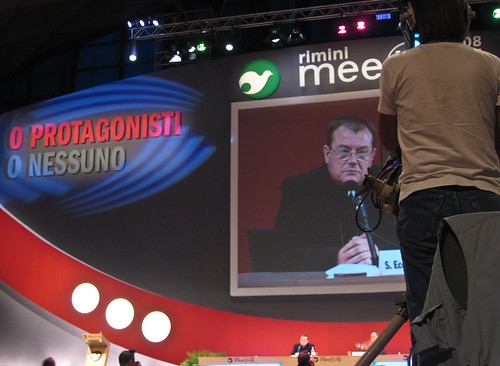
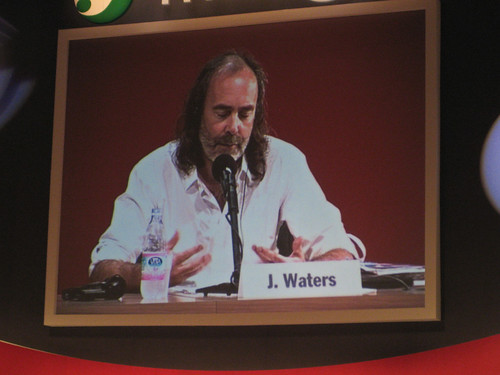
John Waters at Meeting 2008, Rimini

John Waters at Meeting 2008, Rimini

[Journalist John Waters shared the panel with Magdi Allam at the meeting to offer his contribution to the theme: "Protagonists or Nobodies?" As with Allam, coming to the Meeting was decisive in changing his way of looking at the world and of relating to it, as he showed in a story about his daughter. The following are my notes from his talk.]

He said sometimes he imagines a new phenomenon of meeting Jesus, as Andrew and John did, and how it might happen to him. If he were having coffee with a friend, and there was a spare chair, and what if someone sat down there. What exceptionality would it take for him to understand that this is Christ. He wonders how Christ would surprise him and what he would look like. He said it could happen, he doesn't rule it out. But for him the necessity is for an encounter in a cultural moment which is difficulty for all of us.

Our culture has effects on us which are not obvious. We look at reality and think we understand it and how it affects us. But this is not true. The culture is like a jungle that we encounter in the dark. We touch something, and we're not sure if it's a snake or a creeper, whether it's harmless or dangerous. We crawl about looking for signs.

We use the word "secular" to describe society. The word "secular" is an example of the problem. We think we understand it, but it may have no meaning or may be vague. It doesn't express the reality of the phenomenon. We need new words. Waters offered a word: "de-absolutization". The problem is not the decline of the power of churches or of religiosity, but what happens to me. The nutrients I need to survive are removed from the culture.

The question of the Gospel last Sunday from Jesus was who do you say that I am? Before this question, another question has to precede it [for each of us]: Who do I say that I am? How can I describe myself in society? How do I express the yearnings of my heart in a culture that is hostile in ways I don't understand?

On his journey, he was raised as an intense Catholic. But at age 20 he turned his back. Two years ago, he called himself a refugee from a misconception of freedom. He now calls himself a lapsed agnostic. For 20 years he pursued desires in resisting the society he grew up in. The phenomenon of alcoholism for him was a metaphor of society's pursuit of desire, of finding the limits of desire. It was not just a metaphor; he was actually drunk. It was an experience he could describe not as an excess of enjoyment but of his spirit seeking to escape his body and reaching out to a substance and imagining it had the answer. He described it as his soul emerging from his head. [Waters has a dry wit, but self-deprecating jokes don't transcribe well. Come next year to hear him!]

It's important to name the reality of what happens. The culture can give different explanations that appear plausible, which we take for granted. For example, we'll say the problem is psychiatric or a matter of the wrong desires. Another question is that conception of society of man as a machine. It is vital to understand the anatomy of the process of observing how I take for granted things in society as uncontroversial, and how these conceptions are actually inside me too.

In the myth of Narcissus man sees a reflection of himself and is changed. He sees himself as an object outside himself. This mirror is technology. Man creates technology, and it steals his humanity, there is a constant necessity to create new forms of technology. We have gone from the shovel and spade to the plow, tractor, to sitting in a combine harvester and listening to the radio. We can sit and watch the machines we created to do our work for us. It's a strange paradox. His uncles were strong men who worked with their hands. Waters himself writes on a machine and grows weak. So we have to invent a new machine to get strong again. We think this way, so we wake up and instead of having wonder at our own hands, we think: I must get coffee in this machine.

There are many example of things we take for granted, in addition to techology and machines. For example, we take opinion polls. We imagine that if we get the opinions of 50 people we know what everybody in this room is thinking. Why? In the 1930s Gallup discovered something that was true, how we are already fashioned by the ideology of society. It would be more natural to have a million different opinions and to find out what you think: shouldn't we ask you?

The language we use is constructed in such a way that permits me to speak the things that are permitted. It carries a logic that is destroying me. A new phrase we use to abolish the future is "going forward". Not, "I hope things get better" but "going forward" which implies I make the future from my dominion of reality. So the unpredictability of reality is destroyed in language. There are many examples of this.

In the public square, I can say only what is acceptable to say. A colleague of his from the Irish Times recently died of cancer. She spoke of her despair, her fear of death, that death was the end. She was asked two questions. The first was: is there an afterlife. She answered no. The second was whether she believed in God. She said it was a different question. And she spoke of the beauty of creation, art, life, all she hated to leave. She retreated back to say there is nothing. People praised her courage and honesty. For Waters, he thought it wasn't courageous or honest; she was articulate about her despair. She described perfectly, when she had nothing to lose, the abyss the culture has created for us. We conjure this abyss from fatalistic presumption, a joyless perception of ourselves. In the mirror we see hopelessness. Society speaks of progress and happiness, but imagines the worst possible scenario at the end for ourselves.

Recovering from alcoholism, Waters said, "I was an egomaniac with an inferiority complex". This is a way to describe our culture. We believe we create everything, that we are all-powerful, but we have no hope. What is the point? He sees, not because he is a prophet, but he sees in the eyes of others a correspondence to his own desire. The technical arena, the public square is ten years behind the human heart. Only in moments of blurting out do we recognize the truth. We usually sing in the harmony society gives to us. But sometimes someone or you strikes a different note, says something you didn't intend, then people look at you, is this permitted?

Patrick Cavanaugh, a poet, says the nature of poetry is not the words but what happens between the words, a flash of the absolute. The words are the least important thing when the poem is spoken.

As a child, Waters loved a beautiful Jesus, but thought he was an alternative to freedom. He had a choice between the beautiful Jesus and his freedom. He chose his freedom and was regretful. He had no quarrel with Jesus, though maybe with those who spoke for Him. He was so beautiful. He thought himself unworthy, or this was an alibi for the corruption of freedom. When Jesus is gone, he will enjoy himself.

Ian McEwan, in his novel On Chesil Beach, offers a beautiful and terrible description of an argument. Two people say things which are more than they intended, the process accelerates and becomes toxic. They separate. You see this from the internal dialogue. This is what happened to him and Christ. He talked himself into it. Even language sets off an explosion.

Heinrich Boll spoke of Havel who talks of reality beyond the horizon but does not mention God. This is out of courtesy to God whose name has been trampled by politicians, and not for lack of belief. Language is contaminated. So Waters welcomes the proposal of Giussani, who asks no more than that he be honest with himself, to engage and observe his reality.

After twenty years of crawling through the culture, he has come into the clearing. Like in McCarthy's The Road, there is a moment of recognition. People look at him like he hasn't been looked at before. Not piously, which would frighten him away. He needs to make a journey, clearly, logically, to be sure of everything. It would be easy to say yes. He sees Jesus there. But he has to be clear, to see everything. These people look at him this way. Or they don't look at him but at something in him he doesn't know is there, he looks behind himself. Like the character in Taxi Driver: "Are you talking to me?" And they are. They tell him to look at his life, his desire and experience. What does it tell you? Are you happy? No. So they invite him on a journey. He's inclined to turn away, but things happen to them and so he keeps on coming back. They excite curiosity which is bigger than him. They teach him things.

For example, Waters spoke with his 12 year old daughter the other day who was worried about a friend who was moving away. He told her love doesn't end, and that sometimes it is for the better, and not to be overwhelmed. After going to the talk by Michael O'Brien, and hearing how O'Brien blessed his children in bed, as his father also did to Waters with holy water, he was touched. He remembered feeling the imprint of his father's fingernail a half hour later, even after the holy water had dried. Waters had never done this with his own children because of the impediments of the culture. Trying to kneel again, he found his knees wouldn't bend, as if the machine needed to be oiled. The most obvious thing he forgot to tell his daughter that morning and called her back. This is a 12 year old cosmologist who knows the stars well. He told her to speak to the One who knows all the stars. This is the Meeting, the only Meeting he knows of yet, He is there in his reality. He only has to open his eyes.

Thursday, August 28, 2008

Magdi Cristiano Allam at Meeting 2008, Rimini

Magdi Cristiano Allam at Meeting 2008, Rimini

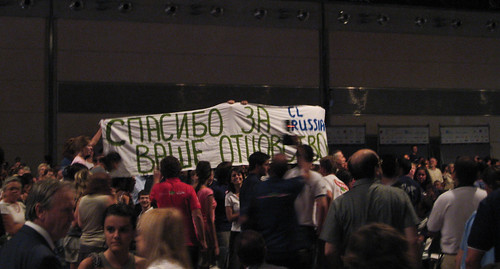
Audience for Allam/Waters at Meeting 2008

[The most dramatic talk for me so far was given this morning by journalist Magdi Cristiano Allam. You may recall he is the former Muslim who was baptized by the Pope this past Easter. He travels with bodyguards as he remains under a death threat as an apostate to Islam. As I was listening to his courageous speech, I was reminded of my visit to the Solzhenitsyn exhibit yesterday, and found Allam a fine successor to the Russian writer in his unflinching commitment to truth. The journalist John Waters (notes to follow) shared the panel with Allam. The following are my notes from Allam's portion of the panel titled, "Christianity is not a doctrine but an encounter: two journalists tell their stories". Pictures to follow.]

Allam told the crowd that they are the protagonists with their certainty of truth in Christ, strong in a solidarity of values and determination to act. He expressed gratitude for CL which he called "my house of values". Within this house, I have met authentic witnesses of faith."

From the time Allam was first invited to the Meeting in 2003 until what he called the most wonderful joy of his life, his baptism on March 22nd by Pope Benedict XVI, in what seemed at first a chance encounter, providence gave this opportunity to him to take or leave.

When he was four years old, his mother was very poor and was a babysitter for a rich Italian family in Cairo. The family sent him to a Catholic school, which was the beginning of Allam's journey. He had the chance to learn of Christianity and to share life experiences with real witnesses of the faith, people devoted to Christ who lived their faith with good deeds, in a totalizing way that envelops our humanity. All this created in him the ethical awareness of life values as the center of existence with the person as the starting point. This ethical basis included the non-negotiable values of Pope Benedict XVI, universal legitimate values such as the sacredness of life and the dignity of the human being as the foundation of civil coexistence, respect for freedom, especially freedom of religion as the core. Along this journey, he was comforted and supported by many witnesses. Christianity is a matter of encounters and the witness of faith through good deeds.

On this journey, at one moment, he said, his spirituality corresponded perfectly with faith in Jesus. Pope Benedict XVI confirmed this in insisting faith and reason cannot be separated. He gave the challenge that everything at the level of reason corresponds to humanity and is perfectly valued even in the Christian religion, the religion of truth, freedom and life.

This is why he became convinced to side with the Pope on many issues, particularly after the Pope's address at Regensburg in 2006 on faith and reason, denouncing violence perpetrated in the name of God. That Islam was spread thorugh the sword is an historical fact supported by Islamic texts. This was traumatic for Allam. After the Pope said this, a brutal and general condemnation ensued with some requesting apologies, others removing ambassadors, and with extremists calling for a death sentence. The Pope was isolated by many critics in the Western media and even from Christian churches and Catholic prelates who found this speech undesirable. This made him ponder, and he recognized that today the West fears looking at the truth. It does not recognize one truth, and it is convinced the truth must stay hidden within ourselves. We are afraid to criticize others so think it is better not to express the truth. The root of this cowardly attitude is the ideological disease of relativism which deprives us of the use of reason. We want to put all religions, cultures, values and knowledge at the same level.

The West is victim of another ideology which is political correctness. In our approach with Islam, we cannot say or do anything to hurt sensibilities. Western culture has another ideological disease, goodism. As long as we give everybody rights and freedoms, everybody is happy. Goodism is the opposite of the common good which is based on rights and duties. Only then will it become good for all.

This led him to reflect on his 56 years of experience as a lay, moderate, liberal Muslim committed to faith and reason. He had worked with great passion and results he was proud of on recognizing fundamental rights, non-negotiables among Muslims. In 2004, he was involved in assembling a delegation of moderate Muslims to make a statement against terrorism. He was involved in affirming faith and reason and democracy. He was condemned to death by extreme Islamists.

This led him to reflect, and he was obliged to study and understand better the theological roots of Islam. Christianity is a religion of God become man incarnated in Jesus. Islam was a religion of text; the Koran was created by and with God and could not be subjected to reason and analysis. There are many verses in the Koran which legitimize the ideology of hatred and of death. Mohammed, by historical documents which are accepted also by Muslims, was a warrior who fought and killed. Some passages testify that he personally participated in crimes, including in the year 627 the decapitation of 700 male adult Jews at the gates of Medina. Muslims do not deny these facts. But he could not be indifferent to facts. His conclusion was of the incompatibility of values he believed and had fought for.

This led him to abandon Islam once and for all. He is condemning Islam as a religion, but he wants to distinguish between the religion and those people who follow it. Individual Muslims must be valued, respected, loved per se. And he finds affinity especially with those who respect human rights and common values. One must work together to build a common civilization. We must do this in the certainty of truth, disenfranchising ourselves from relativism. We should assert the dignity of Christianity and not jeopardize the solidity of our faith. The ability to share values is linked to our ability to be fully ourselves, protagonists of our life, recognizing the truth, that the certainty of the truth is one of the root values in us. Then we can become protagonists in personal and collective action for humanity.

Wednesday, August 27, 2008

Archbishop Paolo Pezzi in Rimini

Archbishop Paolo Pezzi of Moscow at Meeting 2008, Rimini

Greetings for Paolo Pezzi, Archbishop of Moscow

Archbishop Paolo Pezzi of the Priestly Fraternity of St. Charles Borromeo, newly elected to the Moscow diocese, addressed the huge crowd as one of the cielini. He recalled his own younger days of working at the meeting and setting up a stage similar to the one he was now speaking from.

He told us first that it is easy to work, to serve, to obey, as part of something bigger. Don’t tame life to make it easier. He said yes to the Mystery without being fully aware, but discovered over time the features, the face of Another. The real protagonists in history are those living a relationship with Christ.

When the Pope asked him to be the archbishop of Moscow, it was just a different task to serve the Mystery and to know whom to answer is to be free. It is to say yes to Christ just as when he was here setting up the stage. He is participating in a greater project.

We have to answer the mystery of God in the vocation of our lives, to respond constantly to the love that calls us. How can I serve the mystery or to say yes to God? We have the opportunity to remain forever young by saying yes to Christ, which is always yes to real persons and precise circumstances. These are much more than they appear as we become familiar with Christ and become certain of what is good even for those who are apparently against us. This is the ability to recognize Christ under the appearance of what is happening. We will judge persons and things in a different way. This is even to say yes to God when you’re stuck in traffic. We become more interested in finding Christ in circumstances rather than changing circumstances. This is what makes flowers grow in the most arid desert daily.

Many years ago, when he was about 13, his mother was ironing on a hot Sunday afternoon. He asked her why she was ironing when so many other mothers were at the cinema or having fun. She told him: So that I can raise you as good children according to the rule of God. Later in the movement he understood the profound answer by his mother.

Daily life is filled with arid things that are not passionate, even for a bishop, e.g. administration, bureaucracy. One can feel something like being stuck in traffic. Time elapses and it doesn’t change things. Instead, protagonism is offering, saying I offer this to you, Christ. You are the consistency of things. I don’t decide the circumstances. No matter what level you find yourself, you can always offer in any circumstance.

When the Pope appointed him as bishop of Moscow, one objection was that a foreign bishop was being appointed on Russian soil. When the objection was put to him, it was something radical. You feel foreign when you lose consciousness of Christ. Without this relation, he is foreign to myself, nothing is familiar. Familiarity with Christ makes you at home everywhere. What was asked of him was a new beginning. What does it mean to start, what is a new beginning?

A new beginning is not detachment from the past. Even if I conquer the whole world for the most just and beautiful cause, if I lose myself, if I didn’t have a place to go back, it is futile. He feels even more pressing the question how to answer God. Like Peter, Lord, I do not understand, but where can I go? This is an ingenious, profoundly human answer. Faith is an answer to the question of existence, to discover him as the constant answer to my humanity. This is a position of stupor, of the current event of Christ, the flavor of adventure, of life and mission.

He learned to appreciate that in brotherhood his vocation is completed. This is the awareness of a belonging to God that continues. When we don’t know who we belong to, we can’t touch dailyness. Then the day is a blackmail of things to do.

The Gospel of Mark says that the twelve were called to “be with him”, and to be sent daily in Christ. Otherwise living is calculation, rigidity, tiring, with a constant concern for everything. The struggle and vigilance is necessary to not give in to mundane logic.

Cardinal Ratzinger spoke of the loss of Christian identity, so that we don’t bring the reality of faith. The superiority of faith no longer emerges. So whenever there is a meeting there are the usual questions of celibacy, female priesthood. The Church continues to deal with itself. For many, mission is still something to justify, considered like a manhunt. Proselytism begins where mission ends.

Enthusiasm for Christ: I don’t propose myself but Someone Else. For the West mission means announcements, communication, gestures. For the East, mission is the transfiguration of our person with communion with Christ which draws the world to its center, learned from Giussani and others who make Christ fascinating.

After the CL meeting with the Pope last year, the archbishop wrote a letter to the Pope, grateful for how God had reached him through the Holy Father. And he offered himself to go anywhere he would be sent. What he most wants is the life of the other person, drawing people to the miracle of Communion, and this is the opposite of a solitary struggle. This is the preciseness of obedience, bending to circumstances rather than pursuing a project. This is a dramatic moment in the history of Russia.

The mission is to expand the mystery of God that makes me. In the mystery of Christ, everything consists in Him. As Solovyev wrote, what we have most dear in Christianity is Christ himself. Christ encompasses all, his wisdom and goodness. God is not extraneous. If we remove mission, what remains? Nothing. Man is his vocation, passion for the glory of Christ. The mission comes from love of Christ.

The love shown by Christ is yearning. The revelation of Christ removes all other yearning. We no longer live for ourselves but for a true communion toward which all work tends.

Tuesday, August 26, 2008

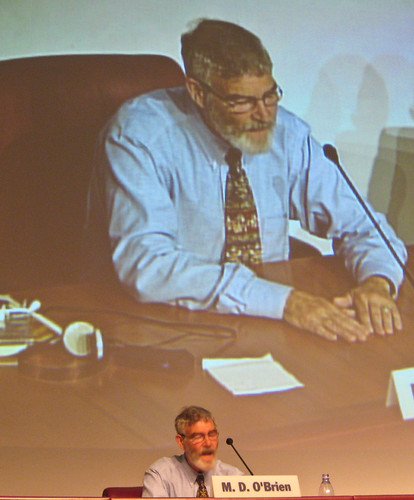
Michael O'Brien at Meeting 2008

I had to fight my way into the first conference at the Meeting 2008 at Rimini by name-dropping (Letizia Bardazzi, remember that!), so instead of standing at the back, I landed a second-row center seat! The hall was already filled with hundreds of people waiting to meet Michael O'Brien, the Canadian author of Father Elijah (which has been translated into eight languages) and some half-dozen more titles published by Ignatius Press.

The unassuming father of eight didn't come to speak about his books, however, but instead addressed the subject of fatherhood and particularly of God our Father, and of his silence which is total presence to us with an immense love.

O'Brien quoted from then Cardinal Ratzinger's address in Palermo in 2000 who offered an urgent message on fatherhood.

Human fatherhood gives us an anticipation of what God is. But when human fatherhood does not exist, when it is experienced only as a biological phenomenon without its human or spiritual dimensions, all statements about God the Father are empty. That is why the crisis of fatherhood we are living in today is an element, perhaps the most important, threatening man in his humanity.

Ratzinger then reflected on the name of God, because God is a Person and has a Name. In the Apocalypse, God's antagonist, the Anti-Christ, is a Beast. He has no name, but a number. In the concentration camps of World War II, faces and names were erased. People were transformed into numbers. This is the spirit of the anti-Christ, to make man a component of the meta-machine, to be reduced only to a function. The anti-Christ makes war on mankind.

In our days, Cardinal Ratzinger warned, we must not forget the monstrosities of history which occur when we adopt the same mentality. The world of the machine becomes normal. The machine imposes the same law as the concentration camp when men are interpreted by a computer, translated into numbers.

God our Father has a name. He calls each of us by name. He is a person who looks at us and sees another person. The true story of man is that we are sons and daughters, and we can never be things. To be a thing is the working definition of materialism, of a soft totalitarianism.

This is homo-sino-deo, man without God, autonomous man. Some have never known a Father, are orphaned, or think they never had a Father. The problem is multidimensional: social, psychological, spiritual.

O'Brien went on to relate three personal stories from his experience as a father which I won't transcribe because too much would be lost without his own delivery. The impression left was of a strong man of faith who encouraged us to trust in God's paternal love for each of us and to accept the sacrifice united to the cross that love needs to expand the heart.

Sunday, February 3, 2008

"Moving beyond the parochial vision"

My pastor told us about a meeting in my diocese looking forward to changes over the next few years. One thing on the horizon is a certain consolidation of services between parishes. This consolidation is a point of anxiety for many folks who fear the loss of parish identity. On the other hand, the bishop reminded us recently that 'we are not congregationalists.' Rather, we are Catholics, and our catholicity requires awareness of how everything is directed 'according to the whole' (kata- holos). And so my pastor appealed to the parish to move beyond the parochial.

I was interested to learn from Fr. Giussani about the development of parishes in the Church:
«The most recent studies show that first the apostles and then their successors, the bishops, long resisted the tendency to multiply local communities out of their desire to preserve true unity in the Church. Thus at first many cities, or dioceses if we can call them such, remained linked to an apostle; then for a long time the dioceses remained centered around the bishop, and the "parishes" - in the modern sense - were few at first. It was only in feudal times that the number of parishes increased; and the clergy remained bound to their own Church, and to their own piece of land ("benefice") rather than to the bishop. One of the spiritual consequences of this was a weakened sense of ecclesial communion and contact with the life of the universal Church. This in turn led to a decadence of the clergy, who tended to isolate themselves and settle for the very limited religious needs of the people.»

(The Journey to Truth Is an Experience, p 110-111)

When I read this passage, it's clear to me why the bishops now reassign priests periodically. It's so that the pastors will continue to be a sign of catholicity to the parishes. And the people, even if they don't move around, need to adhere to the bishop so that they too, will announce the presence of Christ who draws us ever deeper into communion with the totality of the Church.

During Advent I had the opportunity to experience this catholicity during a reconciliation service at a parish other than my own. There were 15 priests there including an auxiliary or emeritus bishop. During this service this parish went beyond the parochial vision - it became the locus for the universal Church. One could see then that it was no longer the church of Corinth but the Church herself in Corinth.

As I lean into Lent, I want to remember those instruments that cultivate in me an ever greater awareness of the totality of the Church. Fr. Giussani reminds us that the early Church used letters of communion (Litterae Communionis) to bind each place in the Church with the whole. And so, I want to be more faithful to Traces - the magazine whose particular mission it is to build up this communion among all. And also, I want the Good Friday Way of the Cross to be a more public sign of communion in Christ.

Tuesday, January 15, 2008

Communion and Liberation: La Sapienza University, another disgrace for Italy

PRESS RELEASE
Communion and Liberation:
La Sapienza University, another disgrace for Italy


Popes have been able to speak everywhere in the world (Cuba, Nicaragua, Turkey, etc). The only place where the Pope cannot speak is La Sapienza, a University founded, after all, by a Pope.
This brings out two extremely grave facts:

1) The inability of the Italian Government to guarantee the right of expression in Italian territory of a foreign Head of State, and Bishop of Rome, spiritual guide for a billion people. In preventing what the vast majority of people expect and want, some small groups find, in fact, protection, even authoritative protection.

2) The cultural ruin of the Italian university which makes it possible for an athenaeum like La Sapienza to transform itself into an ideological “rubbish dump.”

As citizens and as Catholics we are indignant at what has happened and we are sorry for Benedict XVI, to whom we feel even more closely bound, acknowledging him as the defender—in virtue of his faith—of reason and freedom.

CL Press Office

Milan, January 15, 2008.