I have been following the events at Notre Dame with great curiosity, and when I read what Sharon blogged (she has links to everyone else, so just read what she wrote and follow her links) on the subject, I sensed an invitation in her post. So, here I am!
Every time I began to think about the president's invitation to speak at (and to receive an honorary degree from) Notre Dame, a conversation I once overheard would run through my mind. A Catholic philosopher who was teaching at the University of Chicago was speaking to the dean of one of the colleges that is considered more orthodox and serious about its Catholic identity. The philosopher observed that he could always tell which of his students were either Catholic or Jewish from the rest of the students. The dean asked him how he could tell, and the philosopher replied, "The Catholic and Jewish students all have a sense that there are other countries in the world, that people speak other languages, that in the past there were people, people who came from cultures very different from our own, who thought great things and whose works are worthy of examination." The dean seemed bemused and then said, "Well, we know our students are Catholic because daily Mass on campus is packed with students, because they often gather together to pray the rosary, and because a majority of them major in theology, and because they engage in a multitude of pro-life activities." And that was the end of the conversation.
I think that Stephen (not my husband, but a good friend) is right that the people who now decry Notre Dame's invitation to President Obame are (more or less) the same people who have been suspicious of Notre Dame's claim to being a truly Catholic institution. It seems that this controversy provides them with a litmus test -- to judge just how "Catholic" Notre Dame is. Will Notre Dame waver under the barage of email, phone messages and letters of protest, or will she remain "Catholic in name only"?
The question about what makes a University Catholic and what makes its students Catholic seems to be the unspoken heart of the whole brouhaha. There is enormous pressure on the students to "prove" their Catholicism by protesting or even boycotting their graduation ceremony.
What troubles me is that this drive to reject a man (who is after all, our president) seems neither human nor Christian. Many of the children in my atrium pray for President Obama that he may be a good president and make good decisions. A few pray that he will stop killing babies. Both prayers indicate a commitment toward his person, toward his humanity, I think. These prayers imply a relationsionship with the man. If we want these things for him, for his ultimate good, then we must spend time with the man. Jesus spent more time with Pharisees than he did even with the poor and the lame -- at least, his conversations with the Pharisees use much more ink in the Bible. Why? Why did he spend time with them? Why did he pray with them, witness to them? Why did he forgive them from the Cross?
As Catholics, we should think hard about how we approach those who come from other worlds, who speak another language. God has placed this president in our lives for a reason. He exists and leads us for our good, to lead us to Christian maturity (as Sharon so beautifully points out). We should spend some time thinking about what is best for him, how we might help him "to be a good president and make good decisions."
Cross posted at Come to See.
Showing posts with label mission. Show all posts
Showing posts with label mission. Show all posts
Monday, April 6, 2009


Tuesday, October 7, 2008
A truly educational response
Missing premise or not, Prof. Lee's response is too narrow, too abstract, and too prone to misinterpretation to be truly educational- I know a thing or two about being too abstract- and is not likely to persuade anyone who does not already agree with him... (from Deacon Scott Dodge's post, Inherent complexity defies reduction)While it might be argued that Prof Lee's letter to the editor, which appeared in a local newspaper, The Herald Star, only aimed to refute the claim that he and other Catholics are "single-issue" voters, I think that Deacon Scott's point is valid, because at this critical juncture in our history, all that we say or do publicly on the subject of abortion must also attempt to persuade others to the truth.
Our call, as Catholics, is not simply to communicate the truth. We must be concerned with the question of method: How we communicate the truth is much more important than most pro-life activists and apologists realize. Moreover, it is not enough to craft arguments that please and impress those who agree with us. Christ gives us a clear directive when he says, "Go into all the world and proclaim the good news to the whole creation..." (Mark 16:15).
Let's pay attention! What we are called to communicate is good news! Before we open our mouths, pick up a pen, or sit down to our keyboards, it had better be very clear to us that our first job is to proclaim something new, something tremendously good. If we're not up to this task, we would do better to remain silent.
Our method, then, is to find the good news, wherever it may be located (buried or overlooked), and lift it up. This is the heart of fraternal correction and Christian witness.
I myself am guilty of expressing discouragement and waxing polemical when it comes to political questions. This conversation is a good reminder to me that the very first premise, the one that informs all the others, is that I have been preferred, chosen by God to bear his good news -- and not as a result of any good deed I've done or special talent I possess -- God's preference for me is purely gratuitous. From this recognition flows the awareness of another fact: other persons have also been preferred, chosen by God, as well. This dynamic was beautifully described in a witness, given during a CL Summer vacation, a little over a year ago; it is also summed up by Christ's assertion that all the hairs of our heads are counted; and it was articulated in the film, Greater: Defeating AIDS, by Emmanuel Exitu, when Vicky recounts that Rose asked her, "Vicky don't you know that the value in you is greater than the value of this disease?"
Before we speak or write a single word about abortion, or any other evil we encounter, let's remember the infinite and irreducible value of each person. Those who desire the "freedom" to choose abortion are forgetting their own irreducible value. Before they can begin to appreciate the dignity and value of the lives of the unborn, they will need to discover a much deeper affection for themselves and a much broader understanding about where their own value comes from. They will never discover these things if we shun them, insult them, or even deliver fine logical arguments in their general direction.
If I speak in the tongues of mortals and of angels, but do not have love, I am a noisy gong or a clanging cymbal. And if I have prophetic powers, and understand all mysteries and all knowledge, and if I have all faith, so as to remove mountains, but do not have love, I am nothing (1 Corinthians 13:1-2).
Wednesday, August 27, 2008
Archbishop Paolo Pezzi in Rimini
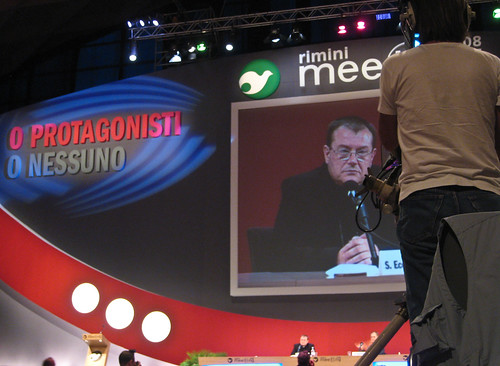
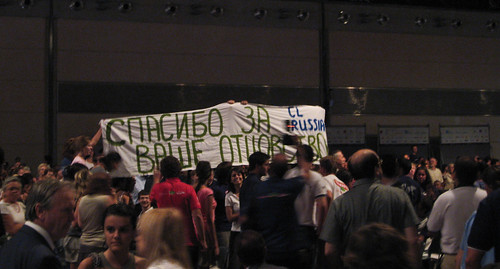
Archbishop Paolo Pezzi of the Priestly Fraternity of St. Charles Borromeo, newly elected to the Moscow diocese, addressed the huge crowd as one of the cielini. He recalled his own younger days of working at the meeting and setting up a stage similar to the one he was now speaking from.
He told us first that it is easy to work, to serve, to obey, as part of something bigger. Don’t tame life to make it easier. He said yes to the Mystery without being fully aware, but discovered over time the features, the face of Another. The real protagonists in history are those living a relationship with Christ.
When the Pope asked him to be the archbishop of Moscow, it was just a different task to serve the Mystery and to know whom to answer is to be free. It is to say yes to Christ just as when he was here setting up the stage. He is participating in a greater project.
We have to answer the mystery of God in the vocation of our lives, to respond constantly to the love that calls us. How can I serve the mystery or to say yes to God? We have the opportunity to remain forever young by saying yes to Christ, which is always yes to real persons and precise circumstances. These are much more than they appear as we become familiar with Christ and become certain of what is good even for those who are apparently against us. This is the ability to recognize Christ under the appearance of what is happening. We will judge persons and things in a different way. This is even to say yes to God when you’re stuck in traffic. We become more interested in finding Christ in circumstances rather than changing circumstances. This is what makes flowers grow in the most arid desert daily.
Many years ago, when he was about 13, his mother was ironing on a hot Sunday afternoon. He asked her why she was ironing when so many other mothers were at the cinema or having fun. She told him: So that I can raise you as good children according to the rule of God. Later in the movement he understood the profound answer by his mother.
Daily life is filled with arid things that are not passionate, even for a bishop, e.g. administration, bureaucracy. One can feel something like being stuck in traffic. Time elapses and it doesn’t change things. Instead, protagonism is offering, saying I offer this to you, Christ. You are the consistency of things. I don’t decide the circumstances. No matter what level you find yourself, you can always offer in any circumstance.
When the Pope appointed him as bishop of Moscow, one objection was that a foreign bishop was being appointed on Russian soil. When the objection was put to him, it was something radical. You feel foreign when you lose consciousness of Christ. Without this relation, he is foreign to myself, nothing is familiar. Familiarity with Christ makes you at home everywhere. What was asked of him was a new beginning. What does it mean to start, what is a new beginning?
A new beginning is not detachment from the past. Even if I conquer the whole world for the most just and beautiful cause, if I lose myself, if I didn’t have a place to go back, it is futile. He feels even more pressing the question how to answer God. Like Peter, Lord, I do not understand, but where can I go? This is an ingenious, profoundly human answer. Faith is an answer to the question of existence, to discover him as the constant answer to my humanity. This is a position of stupor, of the current event of Christ, the flavor of adventure, of life and mission.
He learned to appreciate that in brotherhood his vocation is completed. This is the awareness of a belonging to God that continues. When we don’t know who we belong to, we can’t touch dailyness. Then the day is a blackmail of things to do.
The Gospel of Mark says that the twelve were called to “be with him”, and to be sent daily in Christ. Otherwise living is calculation, rigidity, tiring, with a constant concern for everything. The struggle and vigilance is necessary to not give in to mundane logic.
Cardinal Ratzinger spoke of the loss of Christian identity, so that we don’t bring the reality of faith. The superiority of faith no longer emerges. So whenever there is a meeting there are the usual questions of celibacy, female priesthood. The Church continues to deal with itself. For many, mission is still something to justify, considered like a manhunt. Proselytism begins where mission ends.
Enthusiasm for Christ: I don’t propose myself but Someone Else. For the West mission means announcements, communication, gestures. For the East, mission is the transfiguration of our person with communion with Christ which draws the world to its center, learned from Giussani and others who make Christ fascinating.
After the CL meeting with the Pope last year, the archbishop wrote a letter to the Pope, grateful for how God had reached him through the Holy Father. And he offered himself to go anywhere he would be sent. What he most wants is the life of the other person, drawing people to the miracle of Communion, and this is the opposite of a solitary struggle. This is the preciseness of obedience, bending to circumstances rather than pursuing a project. This is a dramatic moment in the history of Russia.
The mission is to expand the mystery of God that makes me. In the mystery of Christ, everything consists in Him. As Solovyev wrote, what we have most dear in Christianity is Christ himself. Christ encompasses all, his wisdom and goodness. God is not extraneous. If we remove mission, what remains? Nothing. Man is his vocation, passion for the glory of Christ. The mission comes from love of Christ.
The love shown by Christ is yearning. The revelation of Christ removes all other yearning. We no longer live for ourselves but for a true communion toward which all work tends.
Monday, April 7, 2008
Catholics in America
The Pope is coming!
John Allen has a terrific interview posted with the papal nuncio Archbishop Pietro Sambi. The archbishop has some sharp comments on the reason for the Pope's visit, which he emphasizes is not intended to be used ("instrumentalized") for any type of political purpose. Rather the Pope is coming to confirm us in our faith and help us return to our roots and identity. He gives great answers to questions about the Iraq war, the elections, the sex abuse scandal and the meeting with educators.
I particularly like what the Archbishop said about the role of Catholics as a minority in this country:
John Allen has a terrific interview posted with the papal nuncio Archbishop Pietro Sambi. The archbishop has some sharp comments on the reason for the Pope's visit, which he emphasizes is not intended to be used ("instrumentalized") for any type of political purpose. Rather the Pope is coming to confirm us in our faith and help us return to our roots and identity. He gives great answers to questions about the Iraq war, the elections, the sex abuse scandal and the meeting with educators.
I particularly like what the Archbishop said about the role of Catholics as a minority in this country:
How would you analyze the situation facing the Catholic church in the United States?
When you are a minority, as Catholics are in this culture, you need three strong principles. The first is a clear identity, a clear sense of what you are and what you want to be. As a minority, if you lack a clear identity, you're like a drop of wine in a glass of water … you'll disappear. The second thing is a strong sense of belonging. I would express it in this way: you need a community, and the community needs you. Whoever walks alone sooner or later will be lost in the desert. Third, when you are a minority, you need a deep commitment to excellence. You must excel in human qualities, in family qualities, in professional qualities, in the qualities of Christian life, in order to be a light for others. If you don't have a sense of excellence, you will be submerged by the majority.
Sunday, March 23, 2008
From Easter to Mission
Happy Easter! (We're having a white Easter here in Duluth.)
Fr. Carron's recent interview with Alfa y Omega, "An Original Presence", opens up a path to mission, I believe.
First, he speaks of the recent encounter with the Senza Terra movement (what's that called again? :) ), which we have all followed with interest.
Another interesting perspective on dialogue as presence can be found in the Godspy recap of the recent political discussion sponsored by Crossroads.
Christ Is Risen!
Fr. Carron's recent interview with Alfa y Omega, "An Original Presence", opens up a path to mission, I believe.
First, he speaks of the recent encounter with the Senza Terra movement (what's that called again? :) ), which we have all followed with interest.
The Mystery put us in front of this new event, but I am not afraid, because He who started this good work among us will complete it. Our duty is to say yes to this new and mysterious form in which God presents Himself in our life.There is much in this interview, but I am particularly struck by this section about our public presence as Christians, which is what we do here and everywhere. When he says, "reacting to others' provocations is not enough, we are pushed to rediscover the originality of Christianity", I see how much I react to the reactions.
In the present situation where, as we have seen, reacting to others’ provocations is not enough, we are pushed to rediscover the originality of Christianity. A non-reactive, original presence is required. “A presence is original when it comes from the consciousness of its own identity and from the attachment to it. In this, it finds its consistency” (Father Giussani). As Christians, we have not been chosen to prove our dialectic or strategic skills, but just to testify to the news that faith has introduced into the world and that “conquered” us, changing our look toward people and reality. In this context, I believe that the challenge we are faced with is the usual one, since the beginning of the Movement: the educational challenge; educating adults in the faith, according to a method that makes the attachment to Christ reasonable. As Father Giussani said at the 1987 Synod, “What is missing is not the verbal or cultural repetition of the announcement. Today’s man is waiting, probably without knowing it, to experience a meeting with people in whom the fact of Christ is such a present reality that their lives have changed. It is a human impact that can upset today’s man”— that is, the meeting with something that matches our heart’s needs, that shakes reason of its torpor and that can be the answer no moralism could ever dream up.In this our medium is limited, but it is evident that another way than the typical is needed to display the reasonableness of attachment to Christ. The Holy Father gives us an example in his dialogue with Muslim leaders and scholars. Also, the Vatican is initiating alliances with secular and other politicians for causes of human dignity. By affirming human dignity in all its aspects (e.g. moratoriums on the death penalty as well as abortion), the Church is offering a more persuasive view of the person which can move the heart.
Another interesting perspective on dialogue as presence can be found in the Godspy recap of the recent political discussion sponsored by Crossroads.
The motive for bringing Olasky and Hertzberg together was not to conduct an argument between left and right. As one of the event organizers, Carlo Lancellotti explained to me, “Reality is an event, not an idea.” The point was to have an encounter where the role of faith and reason in public life could be explored in friendship. “There is a cultural vacuum” in our society, Lancellotti added. “Politics alone cannot sustain the life of a people. By raising the question of human desire, we can make a contribution.”In this same context, Fr. Giussani said something to those first GS kids who went to Brazil which clarifies this serene openness we are called to:
Just as you have to be faithful to our community and to the values and the directives given for your spiritual life and for educating your persons, so for the activity and behaviour with others and the environment the rule is a deep adaptation: Do not have any pretensions and don't pass a negative judgement on anything.Immediately I see, that's different! This helps me understand how to communicate, whether online or with family, friends, community. It's something other than my instinctive and well-practiced mode. But then, everything about Christ is new. Fr. Carron, on receiving the mandate to guide the Movement for these next years with a more acute awareness of disproportion, quoted Soloviev: "What is dearest to us in Christianity is Christ Himself."
Christ Is Risen!
Subscribe to:
Posts (Atom)