Sunday, April 27, 2008

Thanatos Syndrome: book of the month

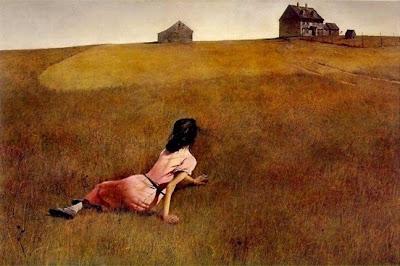
Christina's World
«All at once she became afraid. She was afraid of people, places, things, dogs, the car; afraid to go out of her house, afraid of nothing at all. There are names for her disorder, of course — agoraphobia, free-floating anxiety — but they don't help much. What to do with herself? She did some painting, not very good, of swamps, cypresses, bayous, Spanish moss, egrets, and such. I thought of her as a homebound Emily Dickinson, but when I saw her on the couch in my office — she had made the supreme effort, gotten in her car, and driven to town — she looked more like Christina in Wyeth's painting, facing the window, back turned to me, hip making an angle, thin arm raised in a gesture of longing, a yearning toward — toward what?

In her case, the yearning was simple, deceptively simple. If only she could be back at her grandmother's farm in Vermont, where as a young girl she had been happy.

She had a recurring dream. Hardly a session went by without her mentioning it. It was worth working on. She was in the cellar of her grandmother's farmhouse, where there was a certain smell which she associated with the "winter apples" stored down there and a view through the high dusty windows of the green hills. Though she was always alone in the dream, there was the conviction that she was waiting for something. For what? A visitor. A visitor was coming and would tell her a secret. It was something to work with. What was she, her visitor-self, trying to tell her solitary cellar-bound self? What part of herself was the deep winter- apple- bound self? What part of her was the deep winter- apple- bound cellar? The green hills? She was not sure, but she felt better. She was able to leave the house, not to take up golf or bridge with the country-club ladies, but to go abroad to paint, to meadows and bayous. Her painting got better. Her egrets began to look less like Audubon's elegant dead birds than like ghosts in the swamp.»

Walker Percy, The Thanatos Syndrome, p 4

Such is the earliest sign in Percy's bestselling thriller about Dr. Tom More. Having been absent for two years from Feliciana County, Louisiana, Dr. More is puzzled to discover that this case study's problem has evaporated without a trace. Instead, she is chipper and unproblematic.

Wednesday, April 23, 2008

Columbia 1968

NPR's Robert Siegel judges the events at Columbia University 40 years ago:
Chaos at Columbia University Epitomized 1968
On April 23, 1968, students involved in Students for a Democratic Society (SDS) and the Student Afro Society took over buildings at Columbia University in New York City. Their cause? Civil rights and opposition to the war in Vietnam. Columbia's radio station, WKCR, reported live from each occupied building. NPR's Robert Siegel worked at WKCR at the time, and here he reflects on those live reports.
I wasn't there, but from a description of events from several perspectives, it's evident that taking the dean of the university hostage and occupying buildings by force were acts of violent utopianism. Judge for yourself: 1968 Columbia Protests Still Stir Passion.

Tuesday, April 22, 2008

ROSE Busingye - Please act before April 25

I got this from one of the CL mailing lists:

The documentary "Greater Defeating AIDS …" by the Italian director Emmanuel Exitu, which features the stories of our friends Rosy Busingye, Vicky and the other women of the Meeting Point International , Kampala, Uganda, won the Audience Award at last fall New York AIDS Film festival.


Now the documentary is being shown at the Babelgum Online Film Festival and Spike Lee, the chairman of the evaluation committee of this Online Film festival will designate one film, among the five documentaries best rated by the public online, to be presented at the next world Film festival of Cannes, France.


Rose invites all of us to rate the documentary before APRIL 25th in order to make their stories known even at and from Cannes etc..


This is the procedure:

1. go to http://www.babelgum.com/113782/greater-defeating-aids.htm


2. click on the image ( African women dancing)


3.click " download babelgum free now" ( free and spyware free) and then "save" and save the babelgum-client.exe on the desktop : wait for the download to complete


4.close Internet explorer


5 double click on the icon babelgum-client.exe on the desktop and then click " run" for setup wizard and follow all the steps for the installation.


6. at this moment the babelgum program starts , click on "click here" and wait for the initializing phase to complete


7. then the registration form appears ; if you don't have already an account, click on "sign-up for babelgum " on the right , create your account and fill in the form and sign up


8.the main menu appears ; in the search clips write " greater AIDS" and then click enter


9. select the icon "Greater Defeating AIDS", click on it, choose play


10. the documentary starts playing


11. go with the pointer to the right of the screen : there some icons will appear : the first one is a star; click on the star and five empty stars appear to be filled in to rate.

Albacete on Charlie Rose on Pope's Visit.


A discussion about Pope Benedict's visit to the United States with Jon Meaham, Editor-In-Chief of Newsweek, George Weigel, Senior Fellow of the Ethics and Public Policy Center, Scott Appleby and Monsignor Lorenzo Albacete. Benedict will travel to Washington and New York from April 15-20, speak at the United Nations on April 18, 2008 and visit ground zero on the final day of his trip.

Monday, April 21, 2008

"The whole world is like one big parable"

This, we can say, is the indicator of our faith's truth, its authenticity or lack thereof: if the faith is truly in the foreground, or if in the foreground there is another kind of concern; if we truly expect everything from the fact of Christ, or if we expect from the fact of Christ what we decide to expect, ultimately making Him a starting point and a support for our projects and programs...
The world is a great ambiguity for the unclear spirit. The spirit of man is tempted by ambiguity above every other thing... The whole world is like one big parable: it demonstrates God, as a parable demonstrates the value it wants to teach, and "those who have ears to hear, listen." Listening to the parables, the secret thoughts of the heart are revealed. What man loves come to the surface in the face of the problems, questions, and difficulties...faced with an obstacle, what you want comes to the surface. If living communion, if living community, if working morning, noon, and night for the community, you wanted Christ, you were after Christ, or after yourself, this is seen in the moment in which the difficulty, the obstacle comes to the surface and would insinuate, "forget about it," or would insinuate, "What've they been telling me all this time? They tricked me!" or, "They don't understand me; they don't value me." It is precisely and only in front of objections and during our trials that we see if the attitude of our spirit is wheat or chaff, to use St. Paul's expression. (Father Giussani, "The Long March to Maturity")
Cross-posted at Come to See

Sunday, April 20, 2008

Surprise Visit with the Pope

Following Up on Friday Night's Vigil Outside Migliore's Residence

Henry Artis was helping to organize a prayer vigil at Our Lady of Good Counsel Church on East 90th Street and a procession to the papal residence on East 72nd.

During the Holy Hour at the church, he got a call from one of the Sisters of Life, who were also involved in organizing the event: “There’s a possibility to see the Pope, but we have to go now.” He wasable to invite three friends with him. The group traveled to the tent that was set up in front of the residence, and the Pope came out to greet them. “We thought he’d just say a few words and leave.” But he stayed and greeted each individual.

“I thanked him for being Pope,” said Artis, a convert, “and told him I’m a member of the Fraternity of St. Joseph,” which is the consecrated branch of Communion and Liberation. “He nodded his head and said “Great.” Pope Benedict is an admirer of CL and was a friend of its
founder, Msgr. Luigi Giussani.

Artis, who works at the Metropolitan Museum of Art, noticed that the Pope “loves to be with people.”

“You feel like you’re the only one there because he gives you all his attention.”

-- John Burger

National Catholic Register


Thursday, April 17, 2008

The Mystery of Peter and the Net that Didn't Tear

With the visit of Pope Benedict, it was very apt that our last teaching day of first-year Confirmation class we showed the kids Steve Ray's documentary In the Footsteps of God: Peter. At the start, I told kids to listen to the history, that it was their history, our history, and thus indispensable in understanding ourselves and our destiny. So far so good, but I didn't take my own advice. Pretty soon, I was looking at the clock and critiquing Steve Ray's approach in my mind.

Nonetheless - and this is evidence of God's mercy in Christ! - my heart was penetrated by the encounter with Christ at the sea. They fished all night, and then at dawn Jesus shows up and says try the other side. And behold, 153 fish. One catch to make the night worthwhile (we have labored in vain). How could I not think of this history without thinking of my own work which depends now on making cold calls? I call in the morning, at lunchtime, and in the afternoon - often without reaching many. But one time last week, I called in the afternoon and everybody was there. Such is the mysterious hand of destiny: a hairsbreadth to the side and you'll miss it! So, obey, obey, obey.

The second part of this story is that after following Jesus to His death, the disciples pick up and go back to work, fishing. Jesus says ok, but don't fish so close to the shore, turn around and cast out into the deep. Work is not about eating. Jesus cooked fish that they didn't catch to feed them breakfast. Work is about mission, about announcing the Incarnation, Christ present in history: history now as well as history past. Christ present amid boats and nets or with a CRM filled with prospects and a headset.

The third part has to do with history. History makes us strong. I myself recognize the madness, the unreasonableness of "call reluctance." It's unreasonable to fear the unknown because the unknown has been announced to us, we know the face of the one who waits for us. This one crumb of history last night made today entirely different. It strengthened me, and this strengthening is so important to our destiny and our mission in the world (see, for example, the heartrending account in the current issue of Traces).

Monday, April 7, 2008

Catholics in America

The Pope is coming!

John Allen has a terrific interview posted with the papal nuncio Archbishop Pietro Sambi. The archbishop has some sharp comments on the reason for the Pope's visit, which he emphasizes is not intended to be used ("instrumentalized") for any type of political purpose. Rather the Pope is coming to confirm us in our faith and help us return to our roots and identity. He gives great answers to questions about the Iraq war, the elections, the sex abuse scandal and the meeting with educators.

I particularly like what the Archbishop said about the role of Catholics as a minority in this country:

How would you analyze the situation facing the Catholic church in the United States?

When you are a minority, as Catholics are in this culture, you need three strong principles. The first is a clear identity, a clear sense of what you are and what you want to be. As a minority, if you lack a clear identity, you're like a drop of wine in a glass of water … you'll disappear. The second thing is a strong sense of belonging. I would express it in this way: you need a community, and the community needs you. Whoever walks alone sooner or later will be lost in the desert. Third, when you are a minority, you need a deep commitment to excellence. You must excel in human qualities, in family qualities, in professional qualities, in the qualities of Christian life, in order to be a light for others. If you don't have a sense of excellence, you will be submerged by the majority.


Thursday, April 3, 2008

Preach the Word: in season and out of season

«I know that in pastoral ministry, when people seek advice and counsel, most often the last thing they are looking for is to be challenged in their lives by the Gospel, by the life and teaching of Jesus Christ.» Kαθολικός διάκονος: Living lives of loves

Have mercy on us, Victor King

I would point readers to two remarkable posts by Suzanne, brimming with life, death, sorrow — and an intense mercy.

April fools!
April fools (continued)

Wednesday, April 2, 2008

The Significance of the Second Vatican Council

Vatican II finished 43 years ago. It was a bit before I was born, so I tend to regard the Council as part of the unchanging history of the Church. I didn't always feel this way. From my father and mother, I inherited the 'hermeneutic of continuity' although I also discovered progressivism as one avenue for intellectual curiosity in my early college years. I've read the main documents of the Council, but looking at the following passages (with others, in the context of the whole book), I realize that I've never really grappled with the event of Vatican II.

«The Council has undoubtedly made Church matters more difficult. Those who seek mitigations in everything and express delight at the "progress" and the growing "maturity" as each barrier falls do not understand what the Fathers were concerned with. It was to direct into the secular world through the Church, which is a divine mystery, the mysterious ray of trinitarian and crucified love, wholly and completely. Let us add that this image of the Church — the mediation of the whole love of God to the whole world — is what makes possible true love of our neighbor. The barrier must fall that Augustine set up through his concept of a double predestination to heaven and hell. No, on the contrary, I must be able to hope for every brother so much that, in a fictional Ernstfall, if it were a question of whether he or I would enter the Kingdom, I would — with Paul (Rom 9:3) — let him go. But in order to know what that means, one would have to have uppermost in his mind a theology of Holy Saturday — the descent of Christ into hell — or at least a theology of the dark night of the soul of which John of the Cross gave an experimental description.» (The Moment of Christian Witness, 125-126; emphasis mine)

We cannot shrink from this challenge to bear "the whole love of God to the whole world." This means neither being conformed to the world, nor rebuilding the bastions of the preconciliar Church on a personal level — as if Vatican II never happened.

«If one questions the outcome of the Vatican Council II (and what that is depends to a large extent on us), the answer should surely be this [the defenselessness of Cordula]. We have said already that it should be the Church's defenseless exposure of herself to the world, the dismantling of all bastions and the leveling of all bulwarks to boulevards. And it must take place without any mental reservations or secret hopes of triumph, since our discovery that the old kind of triumph is no longer practicable or desirable.» (136-137)

Instead of hiding out in a Catholic enclave or camouflaging one's belonging to Christ by cleverly phrasing everything in terms palatable to the world — we are called to announce the Mystery whom we have met: simple, risky, and yet the only testimony which is credible.

Tuesday, April 1, 2008

Dialogue in crisis

Lately I've been reading a bit on martyrdom, the blood witness of Christianity. I've reviewed the simple martyrdom described in Corneille's Polyeucte and the martyrdom described in Bernanos's "Dialogues of the Carmelites" characterized by the anguish, the fear of Christ in Gethsemane. Balthasar sees the legend of Cordula as a sign for our own days. In our age, perhaps, it is the fear, the terror of being the object of hatred for Christ's sake, which strikes our heart more than the death itself. But both kinds of martyrdoms are characterized by a love for Him who died for us, and therefore also joy. Christian martyrdom is thus always an encounter between Christ and the disciple.

«The theoretical quality that distinguishes the humanism of the Christian from every other, in actual fact, enters the sphere of dialogue only as a borderline phenomenon, a readiness for the Ernstfall [crisis, the moment of witness].

And now a strange thing happens: it is precisely the readiness, beyond the dialogue, to go much further with one's brother than one can go even in the dialogue that opens the Christian heart to the best possible and longest dialogue. The Christian allows himself to be involved more than anyone else because his partner, perhaps his opponent, is, like himself, someone who is also borne in the crucified Heart. For reasons of prudence he can adjourn a dialogue [i.e. in dying], but he cannot finally break it off. For in the Cross the dividing wall that separates the speakers at the moment has already been torn down (Eph. 2:14) — not by talking, but through the most lonely suffering.»

The Moment of Christian Witness, 124.
I added a line break after the first sentence quoted
I cannot read this passage without being reminded of Charles Péguy, who by remembering and praying a prayer he learned at the parish school suddenly became Christian — despite having lived as a socialist and having married a woman with no sympathy for Christianity. Faithful both to his wife and family and to the Church, he lived and died just within the portal of the Church.

The Ernstfall, the crisis, becomes a vanishing point that gives depth to dialogue, imparts to it a certainty that death is not the end of the discussion. At some point dialogue comes to an end, but the desire for dialogue, the love that impels us to dialogue — remains.

It's hard to read this book without thinking over and over of Flannery O'Connor (in his afterward, Balthasar notes that some complained of its sarcasm). As the Misfit said: "She would have been a good woman... if it had been somebody there to shoot her every minute of her life."